
Clinical Insight
The Science of Saving a Tooth: How Modern Root Canal Treatment Works
A root canal has a fearsome reputation, yet it is one of dentistry's most elegant procedures — a biologically-driven treatment that removes infection from inside a tooth and lets you keep it for life. Here is what actually happens, and why modern endodontics is so predictable.
Inside a tooth: the pulp and root canal system
Beneath the hard enamel and dentine lies the pulp — a soft core of nerves, blood vessels and connective tissue that runs down through narrow channels called root canals to the tip (apex) of each root. In a healthy tooth the pulp nourishes the dentine and senses temperature. Once a tooth is fully formed, it can survive without its pulp — which is precisely why infected pulp can be removed while the tooth itself is kept.
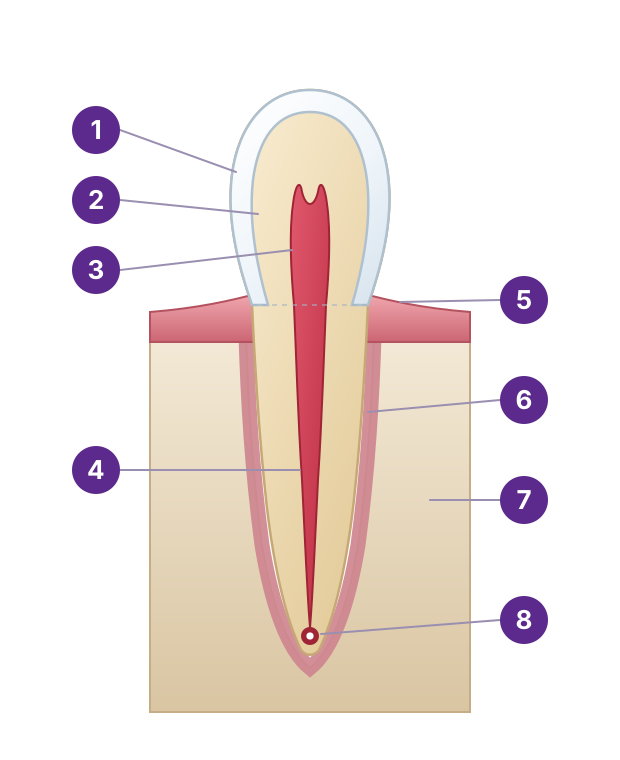
- Enamel — the hardest tissue in the body, covering the crown. It has no nerves and cannot repair itself once a cavity forms.
- Dentine — the living layer beneath the enamel, threaded with microscopic tubules. This is why exposed dentine feels sensitive.
- Pulp chamber — the soft core of nerves and blood vessels inside the crown, extending into pointed pulp horns.
- Root canal — the narrow channel carrying the pulp down the length of the root.
- Gum (gingiva) — the soft-tissue collar that seals around the neck of the tooth.
- Periodontal ligament — the fibrous sling suspending the root in its socket and cushioning chewing forces.
- Alveolar bone — the jaw bone forming the socket that holds the root.
- Apical foramen — the small opening at the root tip where nerves and blood vessels enter the tooth, and the route infection takes into the bone.
How the pulp becomes infected
Bacteria reach the pulp through deep decay, a crack, a leaking old filling, or trauma. The pulp first becomes inflamed — a condition called pulpitis. Reversible pulpitis (brief sensitivity that settles) may recover with a simple filling. Irreversible pulpitis — lingering, spontaneous or night-time pain — means the pulp cannot heal, and root canal treatment is needed before the infection spreads beyond the root tip.
What happens if it is left untreated
Infection that escapes the apex causes apical periodontitis and can form an abscess — a pocket of pus in the bone. This may cause swelling, fever and, rarely, dangerous spread through the tissue spaces of the face and neck. The tooth is also progressively destroyed until it can no longer be saved. A timely root canal interrupts this entire cascade.
The goal of root canal treatment
Endodontic treatment has three biological aims:
- Remove the infected or dead pulp tissue and the bacteria within.
- Disinfect and shape the canal system so it can be filled completely.
- Seal the canals — and crown the tooth — to prevent bacteria re-entering.
The modern endodontic toolkit
Accurate diagnosis
Examination, pulp-vitality testing and a digital X-ray (RVG) — and for complex cases, 3D cone-beam imaging (CBCT) — reveal the number, shape and curvature of the canals before treatment begins.
Rotary NiTi instrumentation
Flexible nickel-titanium files driven by a controlled motor clean and shape even curved canals efficiently and gently — a major advance over hand-filing alone, with fewer procedural errors.
Electronic apex locators
These measure the exact canal length to the apex, so cleaning and filling stop precisely at the root tip — protecting the surrounding bone and improving outcomes.
Irrigation
Disinfecting solutions (such as sodium hypochlorite) flush out debris and dissolve tissue from the intricate canal network that instruments alone can never fully reach.
Three-dimensional obturation
The cleaned canals are filled — usually with gutta-percha and a sealer — to entomb any remaining bacteria and block re-infection.
Single-sitting or two visits?
For many teeth with healthy surrounding bone, a carefully performed single-visit root canal is both convenient and well-supported by evidence. Teeth with significant infection, large abscesses or difficult anatomy may benefit from an inter-appointment medicament (such as calcium hydroxide) and a second visit. The right choice is clinical — it depends on your tooth, not the clinic's schedule.
Why the crown matters as much as the canal
A root-treated back tooth loses structure and can fracture under chewing forces. A well-fitted crown, sealing a sound coronal restoration, is what protects the result. Studies consistently show that root-canal-treated teeth restored promptly with a crown survive far longer than those left with only a temporary or large filling. Reported long-term success for well-treated, well-restored teeth is high — commonly cited in the region of 85–95%.
Common myths, answered
- "Root canals are agonising." With modern anaesthesia they are typically no worse than a filling — and they relieve the pain of infection.
- "It's better to just pull the tooth." Nothing functions as well as your natural tooth. Extraction leads to drifting, bone loss and the later cost of a bridge or implant.
- "Root canals cause illness." This claim traces to debunked century-old "focal infection" research and is not supported by modern science.
Have a painful or previously-treated tooth? Learn about our root canal treatment or book an assessment — call 95726 63116.
Frequently Asked Questions
Can every tooth be saved with a root canal?
Most teeth with infected or dead pulp can be saved if enough sound tooth structure remains and the roots are treatable. Teeth with severe fracture, extensive decay below the bone, or advanced gum disease may not be restorable — your dentist will assess this with an examination and X-ray/CBCT.
What is root canal re-treatment?
If a previously root-treated tooth becomes re-infected — often due to a leaking restoration or missed canal — the old filling material is removed, the canals are re-cleaned and disinfected, and the tooth is re-sealed. An endodontist (MDS) is best placed to handle these complex cases.
Is a single-sitting root canal as good as two visits?
For many teeth with healthy surrounding bone, a carefully performed single-visit root canal has comparable success to multi-visit treatment. Teeth with heavy infection or difficult anatomy may do better with an inter-appointment medicament and a second visit. It is a clinical decision, not a shortcut.